
HARMONY IT
Jullie partner voor toekomst-bestendige zorg in de Benelux
In de basis doen we drie dingen: systemen aan elkaar knopen (zodat data stroomt), standaardsoftware aanvullen of vervangen met slimme apps op maat en meedenken over de inzet van AI.
Maar waarom men van topklinische ziekenhuizen tot regionale woonzorgcentra voor ons kiest gaat dieper: wij weten hoe we complexe IT-omgevingen werkbaar maken voor de mensen aan het bed.
Wij ondersteunen 20+ toekomstgerichte ZORGORGANISATIES















Bewezen expertise bij meer dan 20 grote ziekenhuizen en zorgkoepels in de Benelux.

Onze oplossingen ondersteunen dagelijks meer dan 150.000 zorgverleners aan het bed.

Toekomstbestendig door strikte focus op NIS2, EHDS en internationale security-normen.
ONZE VISIE
Koppelen, bouwen en borgen: zo geven we tijd terug aan zorgverleners
De impact:
Geen dubbele registraties.
Real-time inzicht in de volledige patiëntreis.
Directe tijdwinst voor de werkvloer.
De impact:
Technologie die de workflow versterkt.
Hogere medewerkers-tevredenheid.
Maximale adoptie door intuïtief design.
De impact:
Volledige grip op data-integriteit.
Compliance zonder kopzorgen.
Een toekomstbestendige, veilige infrastructuur.
De impact:
Slimme ondersteuning bij complexe keuzes. Significante vermindering van de werkdruk.
Ruimte voor menselijke aandacht.
ONZE OPLOSSINGEN
Integrale IT-oplossingen voor de complexe Benelux-zorgmarkt

Integratieplatform als ICT-ruggengraat
ETL, ESB, API-gateway, API-Management en Automation. Cloud, API’s en FHIR als centrale bouwstenen, maar ook ruimte ondersteuning voor legacy en on-prem. Alles in één unified platform.
Eigen regie over databeschikbaarheid
Ontsluit data eenmalig en maak hiermee (her)bruikbare informatie veilig bereikbaar naar gelang de vorm van (her)gebruik. Volledig vanuit eigen regie.
Consolideer en beheer jullie transmurale landschap
De groeiende vraag naar transmurale gegevensuitwisseling brengt een wildgroei aan koppelingen. Met het iPaas komen jullie als organisatie weer in control over jullie informatie.
Management van het héle organisatie integratielandschap
Ook buiten de zorg groeien IT-landschappen ongecontroleerd met point-to-point koppeling, gesloten platforms, one-off gateway en brokers. Wij brengen ook die integraties onder één beheer.

Eigen applicatielandschap, volledige controle
Geen generieke software die bijna past. Houd de regie over functionaliteit, data en jullie toekomstvisie. Dat betekent snellere aanpassingen en betere integratie met bestaande systemen.
Werknemersapps die dagelijks 1 uur tijd kunnen besparen
Van roosterplanning tot workflow-applicaties. Wij bouwen apps die zorgmedewerkers ondersteunen met tools die operationele efficiëntie én werknemerstevredenheid verhogen.
Patiënt- en cliëntgerichte applicaties
Ontwikkel portalen en apps die patiënten écht helpen en naadloos integreren met jullie bestaande zorgsystemen en jullie processen volgen.
Veiligheid en security by design
Onze security-first architectuur implementeert gelaagde beveiliging vanaf de ontwerpfase met end-to-end encryptie en zero-trust principes.

Future-ready AI ecosysteem
Harmony bouwt vandaag voor de AI-innovaties van morgen. LLM-integratie en schaalbaarheid ingebouwd vanaf de eerste applicatie.
Van experimentatie naar productie
Proof-of-concepts worden productie-applicaties. Robuuste architecturen met real-time datastromen en betrouwbare machine learning die dagelijks meerwaarde leveren.
AI-ready integratie vanaf de basis
Goede AI-oplossingen beginnen bij goede data-integratie. Onze iPaaS-aanpak zorgt voor toegankelijke datastromen die AI-modellen de juiste input geven voor betrouwbare resultaten.
Strategische aanpak, niet alleen componenten
Denk verder dan losse AI-tools. Wij kijken naar datagovernance, privacy én compliance voor duurzame AI-implementatie binnen jullie ICT-visie.
Jullie collega’s
Waarom zorgorganisaties voor Harmony kiezen



ONZE METHODOLOGIE
Altijd vanuit jullie zorgprocessen en jullie medewerkers

Discovery
In de zorg bepalen we ons succes niet in alleen features, maar in hoe we jullie (zorg)teams, patiënten en cliënten beter helpen ondersteunen. Daarom starten we elk traject met intensieve user research en luisteren we naar wat jullie echt nodig hebben.

Proof of Concept
Hypotheses zijn leuk, maar werkende oplossingen spreken boekdelen. In deze fase bouwen we aan een POC die je zelf kan testen met echte data in een controlled environment.

Architecture
Zorgdata verdient de hoogste (beveiligings)standaarden. Onze architectuur voldoet niet alleen aan alle compliance eisen, maar is ook gebouwd om mee te groeien met jullie organisatie. NEN 7510 compliant, ISO 2701 en AVG-proof.
.svg)
Delivery
Implementatie wordt vanzelfsprekend uitgerold zonder impact op kritieke processen. Maar delivery is meer dan technologie installeren. Het gaat om mensen helpen succesvol te zijn met nieuwe tools. Onze change management aanpak zorgt voor snelle adoptie en minimale weerstand.

Optimisation
Wij zien onszelf niet als leverancier, maar als partner in jullie digitale transformatie. Door continue monitoring, 24/7 service, proactieve optimalisatie en regelmatige reviews zorgen we ervoor dat jullie investeringen van strategische waarde zijn.
concreet maken

Our Blog
Ontdek alle artikels
Generative AI has taken the boardroom by storm over the past couple of years. Today, almost every organisation is experimenting with copilots, chatbots and AI-driven assistants. Yet for many CIOs and CTOs across the Benelux, Nordic and DACH regions, the same question keeps coming back: how do we move from clever answers to controlled action within real business processes?
The market is moving fast. AI today mostly supports the generation of content, insights and analysis. A new phase is now emerging in which AI doesn't just advise, it acts. This is Agentic AI.
It's a phase in which AI no longer simply responds to a prompt. Instead, it helps deliver business outcomes by steering systems, retrieving information, carrying out actions, and collaborating with people and other AI agents. It isn't a chatbot with a job title. It's a governed piece of software that translates goals into action within clearly defined boundaries.
Analysts expect Agentic AI to find its way into enterprise software and operational IT environments more and more over the coming years. At the same time, it's becoming clear that autonomy without sufficient controls introduces new risks around security, cost management and operational stability. The question many organisations now face isn't whether Agentic AI will break through. It's how to deploy it safely, manageably and at scale.
That's the challenge behind the AI Agentic Lab we set up at Harmony. It isn't an experimental playground. It's an environment where we work with clients to explore how AI agents can be safely integrated into existing processes, systems and architectures. The goal is to shorten the distance between a promising pilot and a production-ready solution, and to get a clear picture of what that actually costs. The business models behind AI tooling are still very much in flux, and pricing shifts constantly, which is exactly why the AI Agentic Lab puts serious effort into mapping out the costs of a first MVP or proof of concept.
The Benelux, Nordic and DACH gap: from pilot to production
Across the Benelux, the Nordics and the DACH region, the challenge is no longer generating interest in AI. That interest is already there in abundance. The real gap lies between experimenting and operationalising.
Local market research across these markets tells a consistent story: many organisations now have AI strategies and pilots in place, yet only a small proportion are running AI at scale in production. A lack of specialist integration expertise and complex governance questions are consistently cited as the biggest obstacles to further adoption.
The Harmony AI Agentic Lab sits precisely at that intersection of AI, integration, architecture and governance, starting not from the technology alone but from concrete business processes and measurable business value.
The shift from task-driven to goal-driven
Traditional automation is task-driven. You define in advance which steps need to happen, and in what order. An AI agent works in a fundamentally different way: instead of a task, it's given a goal.
For example: "Reduce the turnaround time of customer files by 15%."
To reach that goal, the agent can analyse process information, identify missing data, consult relevant systems, and propose or carry out next steps. Think of an HR agent that, once a contract is signed, independently assigns IT access rights, orders hardware and sets up an onboarding schedule.
Not every step needs to run fully autonomously from day one. In mature agentic architectures, autonomy is built up in stages:
- Assistive Agent. Advises and suggests actions; the human decides.
- Supervised Agent. Prepares actions; the human approves before execution.
- Bounded Execution Agent. Carries out low-risk tasks independently, within predefined limits.
- Orchestrated Multi-Agent Process. Coordinates activity across multiple systems, with continuous monitoring and escalation.
For IT leaders, this marks a shift away from software that simply reacts to input, towards intelligent execution layers that actively contribute to business objectives.
The real challenge isn't just AI. It's integration
Demonstrating a working AI agent has become relatively straightforward. The real challenge starts when an agent needs access to business-critical systems and live data. That's where the hard questions surface:
- Which datasets is the agent allowed to use?
- What permissions does it get within the ERP or CRM system?
- How do we stop an agent operating beyond its remit?
An AI agent without access to the right systems remains, in the end, a smart conversation partner. Real business value only emerges once AI can read, write and act in a controlled way within day-to-day operational reality.
That's why, within Harmony IT, we build on years of integration expertise. Using technologies such as MuleSoft, Frends, Oracle and OutSystems, we connect agents to the systems behind the scenes, so they can act in a controlled, governed way. Agentic AI then stops being a bolt-on technology and becomes a powerful extension of your existing application landscape.
RAG: from model knowledge to business knowledge
Public AI models don't have access to your internal documents, policies or contractual agreements. That's why many enterprise AI solutions are built on Retrieval-Augmented Generation (RAG).
RAG gives an agent controlled access to relevant business information at exactly the moment it's needed. This makes outputs better substantiated and traceable back to their sources, grounds answers more firmly in validated business information, and significantly reduces the risk of hallucination.
From standalone agents to a governed ecosystem
In practice, a process is rarely handled by a single agent. Increasingly, we see specialist agents working together: a service agent for customer queries, an integration agent for data retrieval, a compliance agent for checks, and so on.
Together, they form an ecosystem with clearly divided responsibilities. Human-in-the-loop oversight remains essential here, not because the technology falls short, but because context, accountability and strategic judgement call for it.
Governance doesn't have to be a brake on innovation
As AI is given more autonomy, governance matters more, not less. For organisations operating under the strict rules of GDPR and the EU AI Act, which is being phased in step by step, that's simply non-negotiable. Coverage does vary slightly across the region: GDPR applies directly within the EU and, via the EEA, in Norway and Iceland, while Switzerland works to its own broadly equivalent FADP. The EU AI Act itself is an EU instrument, so organisations in Switzerland and the EEA states should check how, or whether, it applies to them directly.
Within the Harmony AI Agentic Lab, we work to a principle we call Governance by Design. An agentic environment is never just one model. It consists of a reasoning layer, an integration layer, and robust Identity & Access Management (IAM). With explicit identities for agents, fine-grained access rights and comprehensive audit trails, we make sure AI behaves predictably, verifiably and responsibly. Security, guardrails and data sovereignty are non-negotiable parts of that picture too.
From demo to digital colleague: the Harmony Agentic Lab
Over the coming years, many organisations will build AI agents. Some projects will remain impressive demos. Others will grow into a fundamental part of the business.
The difference won't come down to the model alone. It comes down to the quality of the integrations, the enterprise architecture, the governance, and the ability to let AI collaborate safely with people and systems.
That's why we set up the AI Agentic Lab at Harmony: to help organisations make the leap from experiment to production, and from AI tool to digital colleague.
Together, we explore which processes hold the most potential, what architecture is needed to let agents work safely alongside existing systems, and what governance measures are needed to keep risk under control.
Rather than one-off demonstrations, we focus on concrete outcomes:
- identifying and validating use cases;
- a business case and ROI estimate;
- architecture and integration blueprints;
- governance and security frameworks;
- working prototypes;
- a roadmap to production.
The result is a structured pathway that lets organisations grow, in a controlled way, from experiment to enterprise-wide adoption.
Explore. Experiment. Accelerate.
Not to demonstrate AI, but to make it actually work.
Ready to move from demo to digital colleague? Discover what the Harmony AI Agentic Lab can do for your organisation, and turn experiments into measurable business value. Get in touch with us today.

AI agents are shifting rapidly from answering questions to taking actions. They retrieve customer data, trigger workflows, create documents, communicate with business systems, and automate decisions. With that new power comes a new challenge: as agents grow more capable, the consequences of failure grow considerably larger too.
At the recent OutSystems ONE 2026 Conference, security and governance came up again and again in the conversations around agentic systems. The pattern is hard to miss: building an agent gets easier every month, while securing it stays genuinely hard.
At Harmony Group, we increasingly work with organisations that want to go agentic, and one lesson keeps proving itself: security cannot be treated as an afterthought.
The Big Misconception
When people talk about AI risk, they often think immediately of data privacy. Questions such as:
- Will our own data be used to train public models?
- Are we masking personally identifiable information (PII)?
- Can sensitive customer information leak into prompts?
These are important questions, and sound privacy controls remain indispensable.
But privacy and security are not the same thing.
The incidents that surprise organisations most are often not privacy problems at all, but failures in system design, governance, and security. Attackers increasingly target AI systems through techniques such as prompt injection, jailbreak attempts, poisoned content, and compromised integrations. The goal is often not to reach data directly, but to manipulate the agent's behaviour.
If an AI agent is manipulated into ignoring its instructions, exposing sensitive processes, or carrying out unintended actions, the model provider is not the only party affected. The organisation operating the agent carries the responsibility, and the reputational risk along with it.
What This Looks Like in Practice
Abstract warnings about "prompt injection" only become tangible with a concrete example. Take EchoLeak (CVE-2025-32711), a vulnerability in Microsoft 365 Copilot discovered in 2025.
What made it dangerous? It was a zero-click attack. The victim only had to receive a malicious email; opening it was not even necessary. As soon as the user later asked Copilot to, say, summarise some documents, the AI also read that email in the background. The attacker's hidden instructions were carried out directly, quietly leading to a leak of company data.
No firewall was breached and no passwords were stolen. The assistant simply did what it was meant to do: read and process content. The instructions just came from the wrong person.
The structural problem: indirect prompt injection
This phenomenon is called indirect prompt injection: hostile instructions that do not come from the user themselves, but sit hidden in external content the AI takes in. It was described in theory as far back as 2023 (Greshake et al.), but EchoLeak proves it is now a real risk to enterprise software.
Security researcher Simon Willison explains this vulnerability through the "lethal trifecta". Any AI system that combines the following three properties is, by design, susceptible to data theft:
- Access to private data.
- Exposure to untrusted content (such as emails or websites).
- The ability to communicate externally.
Because most useful enterprise agents need precisely these three functions to do their work, securing them is so extremely complex.
An Architecture Problem
One of the biggest mistakes organisations make, therefore, is assuming that AI security can be outsourced to the model provider.
Modern AI systems are far more than a single LLM. They consist of prompts, orchestration layers, APIs, databases, vector stores, external tools, business logic, and user interfaces working together.
Even the most advanced model can become a security liability the moment it is built into an insecure architecture.
The real challenge, then, is not securing the model itself but the entire ecosystem around it. And that calls for a broader view of how agentic systems are designed, deployed, and governed.
A Way to Think About the AI Stack
It helps to see agentic systems as a layered problem, where each layer introduces different risks and calls for different protections. It is less a proprietary framework than a practical way of making sure nothing gets overlooked.
Broadly, it breaks down into three domains.
1. The Capability Layer (Models)
This layer contains the large language models, embedding models, and reasoning engines that power the agent.
These models are incredibly capable, but they are not deterministic security systems. They can be influenced by carefully crafted input and remain susceptible to prompt injection and jailbreak techniques. Prompt injection sits at the top of the OWASP Top 10 for LLM Applications, and understanding those limitations is the first step towards a secure implementation.
2. The Intelligence Layer (Pipelines and Orchestration)
This is where the real business logic lives. The intelligence layer connects models to APIs, databases, enterprise applications, knowledge sources, and other agents. It orchestrates workflows and determines how information flows through the system.
Classic cybersecurity concerns remain highly relevant here. Compromised credentials, exposed API keys, vulnerable integrations, or insufficient access controls can allow attackers to bypass the user interface entirely and communicate directly with backend services.
This is also where the most under-appreciated agentic risk lives: excessive agency. OWASP lists this as a distinct top-ten risk for LLM applications, and it is arguably the defining agentic vulnerability. An agent has excessive agency when it holds more capability, permission, or autonomy than the task requires: too many tools, overly broad API scopes, or the ability to take consequential actions (send, delete, pay, escalate) without a human check.
EchoLeak is dangerous because Copilot could both read private content and act within a context that untrusted input could reach. Break that combination (separate reading from any external action, require confirmation before consequential steps, grant the narrowest permissions the task needs) and the same injection attempt fails without harm. In practice, agentic security is largely about the disciplined management of what an agent is allowed to do, not just what it is allowed to read. As agents gain access to more enterprise systems, governance at this layer becomes critical.
3. The Experience Layer (User Interaction)
The experience layer covers the applications, portals, and interfaces through which users interact with agents.
This is often where malicious input enters the system. Users may, deliberately or unwittingly, supply misleading, contradictory, or manipulative instructions. And as EchoLeak shows, hostile input does not always come from the person at the keyboard; it can ride in on any content the agent takes in. Without proper safeguards, those inputs can influence behaviour further down the chain and produce unexpected outcomes.
Public-facing agents should therefore be designed on the assumption that hostile input is ultimately inevitable.
How We Approach Secure AI at Harmony
There is no universal security framework you can simply drop onto every AI project. Security starts with context.
Define the threat model first. A customer-facing support agent faces completely different risks from an internal HR assistant or an AI-driven clinical decision-support tool. Before you build in controls, you need to understand the specific risks of the use case you are solving.
Trust no input, wherever it comes from. User prompts, retrieved documents, emails, and responses from external APIs all deserve the same treatment as external input entering a classic application. Validation, separation of responsibilities, and controlled access remain essential.
Constrain agency deliberately. Give an agent the fewest tools and the narrowest permissions its task requires, separate read access from write and send access, and put a human in the loop for consequential or irreversible actions.
Put guardrails and governance in place. Modern AI platforms increasingly offer dedicated governance capabilities. Where a low-code platform such as OutSystems, with Agent Guardrails, focuses on monitoring and protecting prompts and responses at the application level, MuleSoft extends that governance into the data and integration layer. Through MuleSoft you can enforce strict API policies on the gateways that connect LLMs and (external) AI services to your enterprise systems. Such controls do not eliminate risk, but they form an important layer within a broader defence-in-depth strategy.
Stay close to the research. The AI security landscape changes at a remarkable pace, and many emerging attack techniques surface in research papers long before they become mainstream in the industry. Staying informed means following academic research, security communities, and frameworks such as OWASP's guidance for the security of LLM and agentic applications.
Building for Enterprise Requirements
At Harmony IT, we do not just help customers adopt AI. We also work out how to keep it running in tightly regulated environments, with private development ecosystems, controlled CI/CD pipelines, and reusable AI assets that fit real compliance requirements.
We also experiment through internal research and community projects, including work on AI benchmarking and evaluation tooling, because you cannot secure or trust what you cannot measure.
The Road Ahead
AI agents are rapidly becoming part of the IT landscape. The question is no longer whether organisations will deploy them, but how they will do so responsibly.
Security can no longer be a compliance checkbox added at the end of a project. It has to sit in the architecture from day one.
Because while building an agent gets easier every month, building one that stays trustworthy under pressure is the real engineering challenge.
Putting agents into production and want a fresh pair of eyes on where they might have too many permissions? That is a conversation we are glad to have.
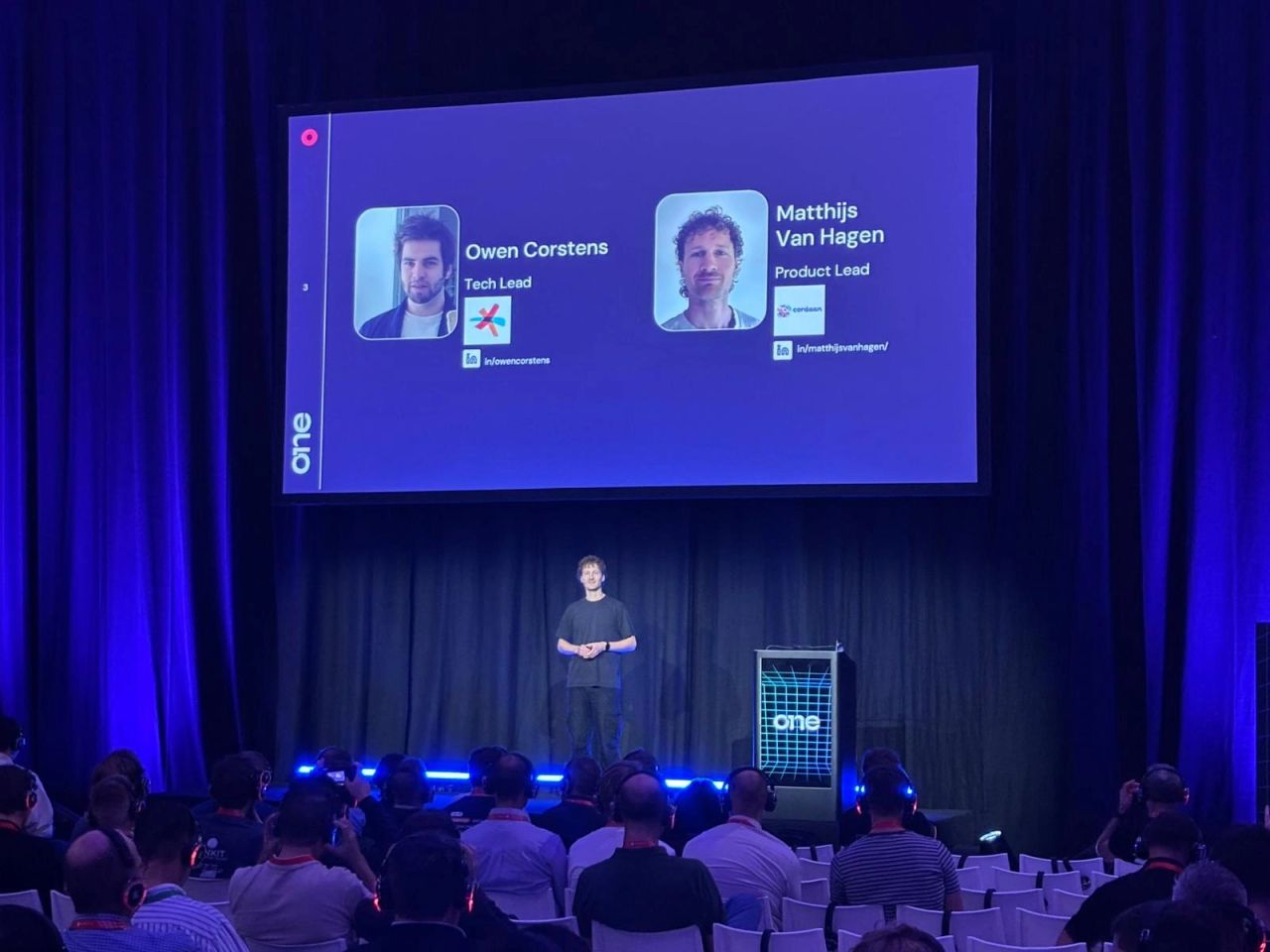
At the recent OutSystems ONE Conference, Matthijs van Hagen (Product Lead at Cordaan) and I shared the stage to tackle a fundamental problem in the healthcare sector. For those who don't know the organisation: Cordaan is one of the largest care providers in and around Amsterdam. With roughly 6,000 employees, they support more than 20,000 clients across elderly care, disability care, and mental health care.
The operational complexity of an organisation like that is enormous. Matthijs set out a challenge every CTO will recognise: an abundance of fragmented point solutions. Cordaan's care workers were losing themselves in a maze of apps for medication, care plans, and protocols.
With Cordaan Werkt, we used OutSystems to build a central "super-app" to counter that fragmentation. The latest addition to it is an advanced implementation of RAG (Retrieval Augmented Generation).
What is RAG, and why is it crucial in healthcare?
For anyone who doesn't yet use the term daily: RAG is an architectural pattern that couples a large language model (such as GPT-5) to a specific, external information source.
Using generative AI in a clinical or care-related context is risky if you rely solely on public LLMs. The chance of hallucinations is simply too great. At the same time, the digital library of a large care institution is often a graveyard of unused PDF protocols.
RAG bridges these two worlds. Instead of hoping a model "knows" the right information, we force the AI to formulate answers based exclusively on Cordaan's own, validated source documents. This process runs through a tightly defined pipeline: retrieval of relevant chunks, augmentation of the prompt, and finally generation of the answer.
When a care worker asks a question, the system first finds the most relevant fragments in the internal protocols (Retrieval). This factual information is then passed as context to the AI model (Augmented), which formulates an accurate answer on that basis (Generation). This minimises the chance of hallucinations and ensures the output is always directly verifiable against the source.
The architecture: from test phase to evolution
During our presentation at the ONE Conference, we showed the blueprint we used during the initial test phase. It's worth noting that this architecture formed the basis for our proof-of-concept. Since then the architecture has partly shifted as we scale towards broad production, which is telling of the speed of this technology.
The foundations of that phase were:
Azure AI Search as orchestrator. During the test phase we used Azure's indexing capabilities. At that point we relied mainly on BM25 search for lexical precision and complemented it with semantic search to raise contextual relevance, without the overhead of a full vector database.
Intelligent chunking. We developed our own character-based chunking mechanism with a strategic overlap. This ensures the semantic value is not lost when documents are split up, which is essential for accuracy.
OutSystems AI Workbench. This acted as the secure gateway to the LLM, where we kept full control over the data flows and the integrity of the prompts.
Lessons learned: strategic insights for AI in healthcare
Our journey with Matthijs at Cordaan surfaced a number of crucial lessons that are essential for any care institution getting started with AI:
Start with a "human-in-the-loop" mindset. AI should assist, not dictate. The feedback loop where care workers can rate answers as "useful" or "not useful" is not only technical validation, but also an essential part of the adoption process on the ground.
Pragmatism beats complexity. In the test phase, the temptation is strong to go straight for the most expensive vector databases. Our lesson? Start simple with lexical search and expand to semantic search when the use case calls for it. That saves considerable cost in the early stages.
Data hygiene is the bottleneck. The model is only as good as its source. We found that cleaning up old PDF protocols has more impact on the quality of the answer than fine-tuning the AI model itself.
Architectural flexibility is a requirement. As our own shift after the test phase proves: the AI market changes weekly. Build your solution modularly so you can switch provider or model relatively easily, without rewriting your entire application logic.
Guardrails and keeping it human
As Matthijs stressed, at Cordaan AI is an assistant, not a replacement. That translates into hard technical boundaries: the bot is explicitly configured as a non-medical tool, every answer contains direct citations to the source, and privacy filters safeguard anonymity before data leaves the domain.
Looking ahead: from RAG to Self-RAG
Although the architecture around the provider and implementation has since shifted compared with our first presentation, the vision remains unchanged. We are now looking at patterns such as Self-RAG, where the model itself assesses the quality of the retrieved information before the user sees it.
The lesson for the sector is simple: the technology is a means, not an end. By starting pragmatically, learning critically from your test phase, and being willing to adapt your architecture to real-world practice, you can already give care workers back time today for what really matters: the client.
Curious about what our current architecture looks like after the latest shifts, or want to talk through the specific lessons learned, or AI within your own organisation? Do get in touch.
Wij sparren graag over uw ambities